Curriculum alignment is the work done to adjust or map competence aims and learning outcomes to content, assessments, learning activities and teaching methods. Clear alignment helps the teachers find learning resources for their students so that they can learn, and thus work towards and reach learning outcomes and competence aims. Curriculum alignment is part of an effort to support the teacher´s on their journey of teaching and to improve student performance.
Curriculums vary from country to country and in different parts of the world. Most curriculums of recent dates emphasize not only factual knowledge and subject aims, but also general aims. Foundational skills for life, such as reading, writing, mathematics, communication and digital literacy, are some of the foundational skills stressed in many curriculums. Core competencies often focused on are critical thinking and problem solving, creativity and innovation, collaboration, personal development, global citizenship and learning behaviors to mention some.
Placing the learner at the center of learning is essential. Inclusion and differentiation is crucial to make sure all learners have the best possible chance of learning. Modern curriculums also focus on pedagogical approaches where some of the goals are meant to ensure that the learners feel empowered and independent, that learning is relevant to the students, where there is assessment as learning, for learning and of learning to promote in-depth learning.
The curriculum in Ghana
An example of a fairly new and modern curriculum is the curriculum in Ghana. Basic 1 to 3 in both Mathematics and English meet all the criteria mentioned above. Each strand has its content standards, the aim itself, indicators and exemplars, for example different methods and ways to count to find out “how many?”, as well as subject specific practices and core competencies. In the Ghanaian curriculum, the teachers are presented with many examples on how they can work with the aims in class. In many ways, the teachers have a teacher's guide in the curriculum itself.
The Norwegian curriculum
Another example is the Norwegian curriculum. It is from 2020, and meets the criteria above as well. However, where the Ghanaian curriculum has focused on lifelong skills, values and core competencies in the subject curriculum, the Norwegian has a separate part presented as addition to the curriculum covering this for all subjects. Also, the Norwegian subject curriculums have a chapter on the four foundational skills tailored towards that specific subject. The subject specific aims in Mathematics are different from year to year, whereas for the subject Norwegian, they are the same for grade 1 to 4, 4 to 7, 7 to 10. In addition, no teaching methods, learning activities and so on are presented in the curriculum. Deciding what to teach and how to teach it, is completely up to the teachers in each school. In most schools, teachers create weekly, monthly and yearly plans for their teaching together with other teachers.
The United States and the Common Core State Standards
In the United States, there is no national curriculum. However, there are the Common Core State Standards. The Common Core State Standards (CCSS) are the goals that have to be reached by the students. They were not developed by the Federal government, but they were fully adopted by the Department of Education at the Federal level. States are not required to adopt these standards, but if they do not, they will have to prove that their standards will get children college ready. Most states have adopted the standards and passed them on to the local districts. As a result of this, most publishers have changed their offerings to match these standards. How the standards are implemented in the classroom is up to the teacher depending on how strict the superintendent is. Some give teachers a lot of freedom, others very little. If a district adopts a particular curriculum, it is generally expected that the teachers implement that curriculum.
Curriculum alignment and the GDL in Ghana
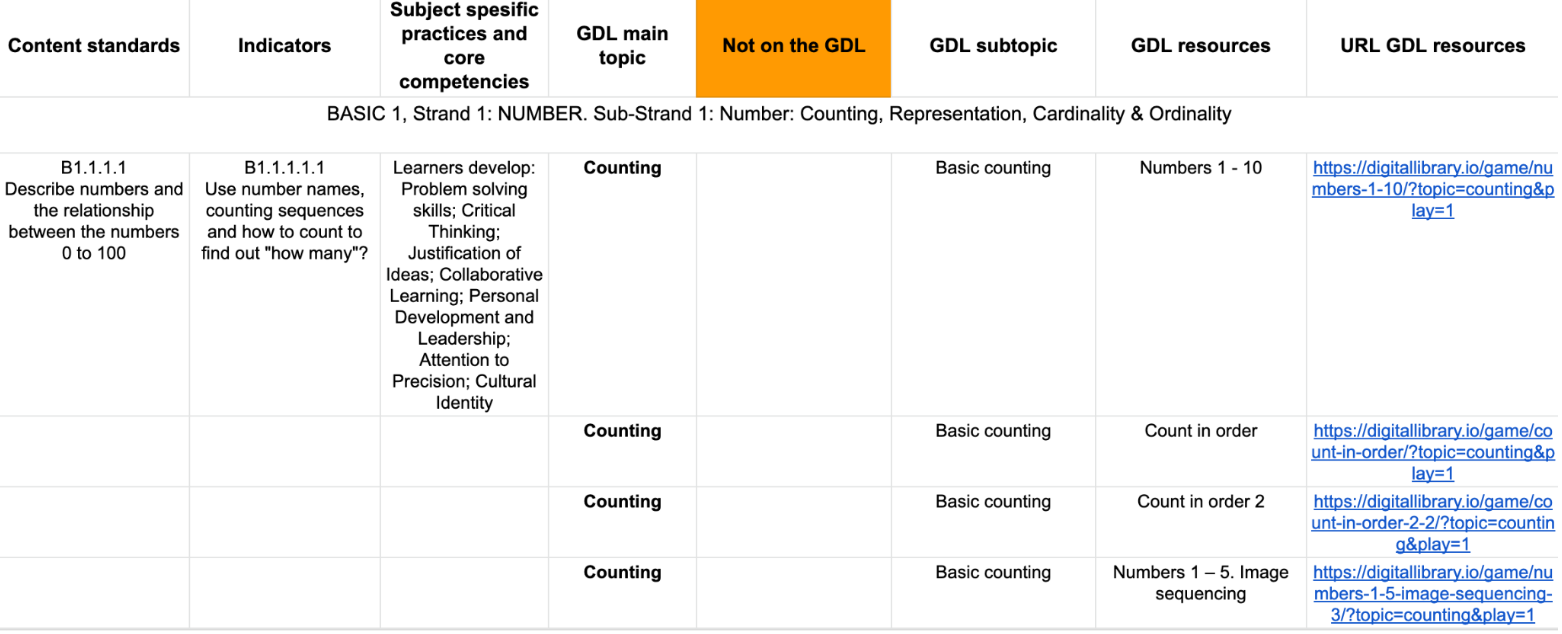
The GDL content can be curriculum aligned to any curriculum or learning structure. Ghana is the first country where the GDL resources are integrated into the national curriculum for Mathematics and English. The GDL team has mapped the GDL content to the levels 1, 2 and 3 for Mathematics and English. In Mathematics, our content covers most of the content standards from Basic 1 through 3. We have looked at each of the content standards, and mapped them with specific early math games from the GDL in a spreadsheet. This is an example from the spreadsheet:
The content standard B1.1.1.1 is: Describe numbers and the relationship between the numbers 0 to 100. The indicator B1.1.1.1.1 is: Use number names, counting sequences and how to count to find out “how many”? To teach to this standard and indicator, the teacher can use all the 14 games from the GDL that belong to the topic Counting. In addition, the student can study two instructional videos on how to count by putting objects in a box, and by counting in order. Also, the child can assess itself with a Level up game, to find out whether it masters the topic or not. With 80% correct on the test, the child automatically is moved up to the next level, called Counting objects. If the child gets less than 80%, it is advised to work more on the topic before it plays the Level up game again.
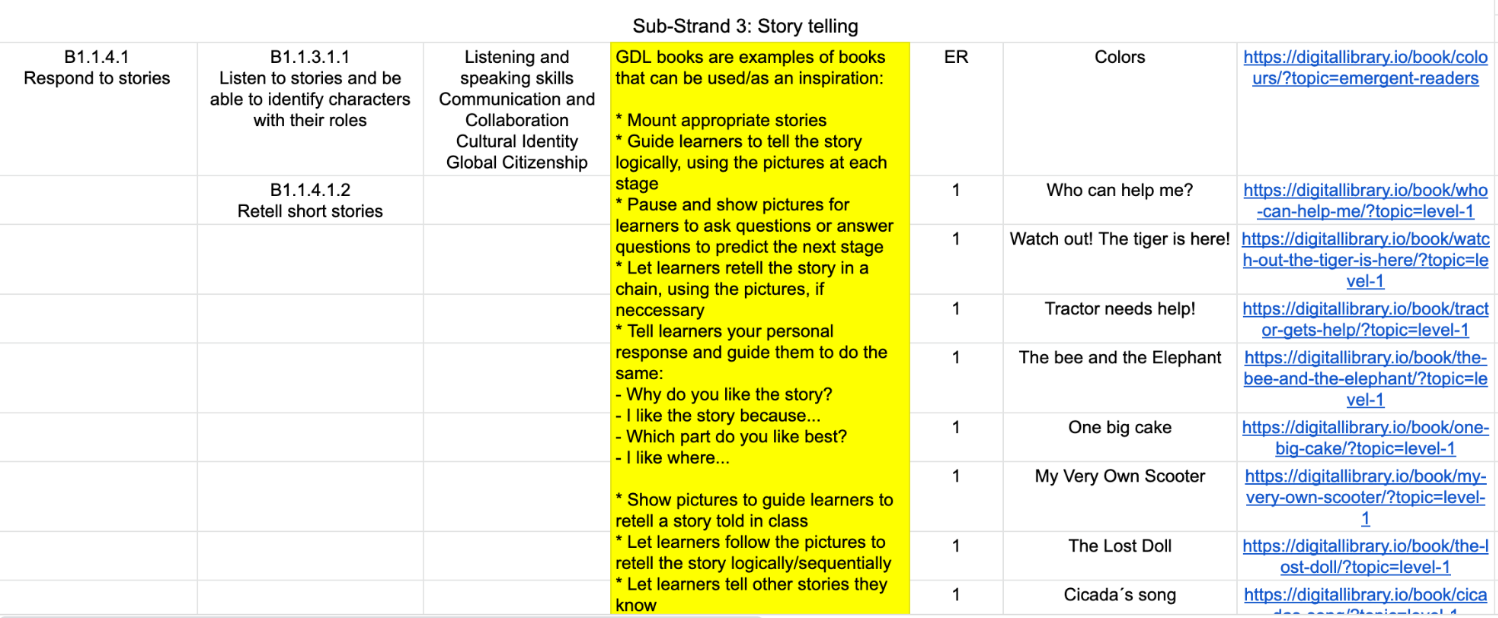
In English (Reading), the GDL content consists of books on different levels and topics. There are books for Emergent Readers with wordless books, as well as books on Level 1 through 5 and Read Aloud. Here is an example from the spreadsheet:
The content standard B1.4.1 is: Respond to stories. B1.3.1.1 is: Listen to stories and be able to identify characters with their roles. When mapping the GDL content to the content standards in English, the team has selected good story books that can be used in class when teaching and learning about storytelling. The books chosen in Basic 1 are mostly from Level 1, but some are also Emergent Reader (ER) or from Level 2. These books have been specifically chosen because they fit the “teacher's guides” marked with yellow. They all have beautiful illustrations, and can be used to “Show pictures to guide learners to retell a story told in class”, “Let learners follow the pictures to retell the story logically” and “Guide learners to give personal responses to: Why do you like the story? What part do you like best?”.
Curriculum alignment and the GDL in Jamaica
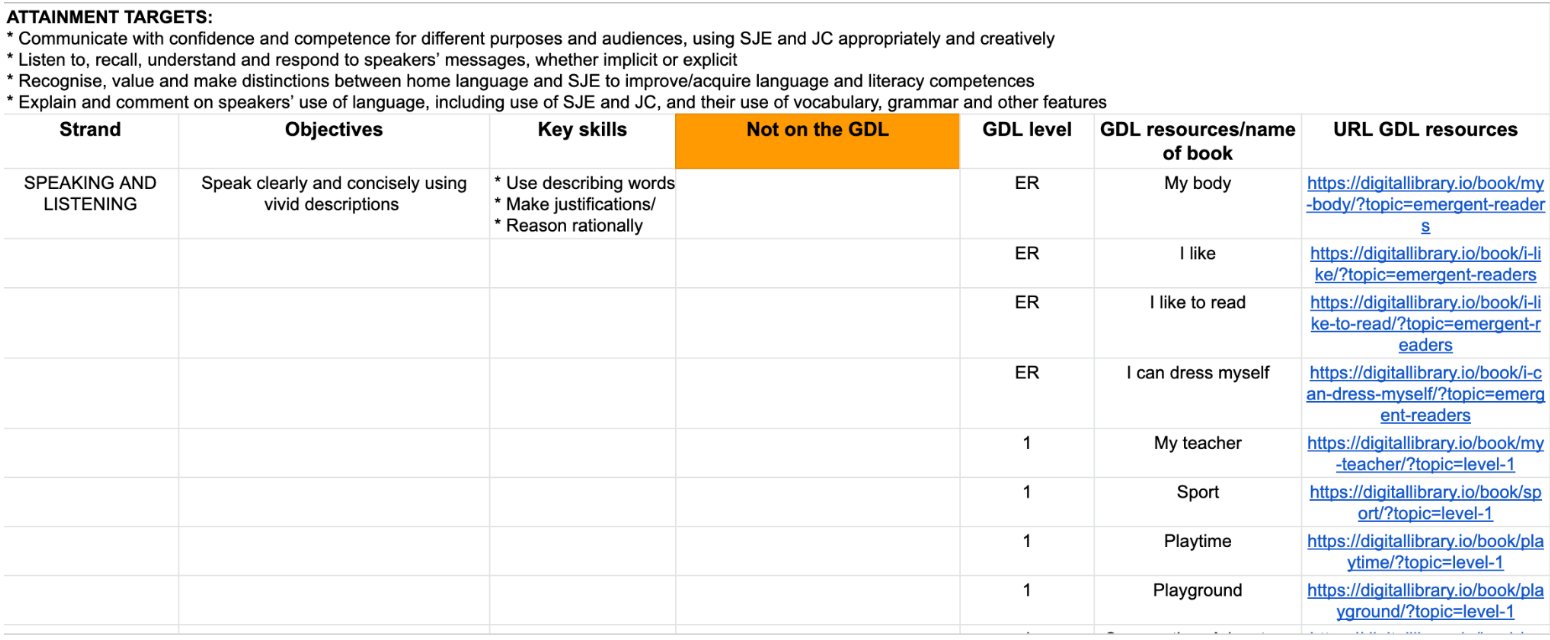
The GDL team has also begun to map its content to the curriculum for Language Arts, Grade 1, in Jamaica. Here is an example:
When learning key skills such as use describing words and make justifications when working with the strand Speaking and Listening, the GDL team has suggested books in an appropriate level that makes the child able to describe for example his or her body, the child's teacher and the school's playground. Books such as I like, I like to read and I can dress myself are books where the child needs to make justifications or explain what it likes and why, and what it can and why.
Curriculum alignment and the GDL in Norway
The GDL team has looked more closely at the Norwegian curriculum in Mathematics, and seen that our content matches many of the competence aims. One example is: Order numbers, sets and shapes based on their properties, compare them, and reflect on whether they can be ordered in more ways. GDL content that can be used to teach and learn about this can be found in for example the main topics Basic counting and Geometry. Another example is: Explore addition and subtraction and use this to formulate and solve problems from play and one´s everyday life. Relevant GDL content can be found in the main topics Addition and subtraction intro, Addition and subtraction within 20, Addition and subtraction within 100 and Addition and subtraction within 1000.
Curriculum alignment and the GDL in Illustrative Mathematics
When taking a closer look at the CCSS in Mathematics for kindergarten, they are divided into main goals and sub goals. An example of a superior area in Mathematics in the CCSS, is Counting and Cardinality, K.CC. The child is expected to know number names and the count sequence. In further detail, he or she should learn how to:
Count to 100 by ones and by tens.
Count forward beginning from a given number within the known sequence (instead of having to begin at 1)
Write numbers from 0 to 20. Represent a number of objects with a written numeral 0 – 20 (with 0 representing a count of no objects).
One of more curricula in Mathematics is Illustrative Mathematics. Illustrative Mathematics is “a problem-based core curriculum rooted in content and practice standards to foster learning and achievement for all” (https://curriculum.illustrativemathematics.org/K5/curriculum.html), and has teacher materials and teacher guides for all grades. Kindergarten, lesson 12 “How many are there?” is addressing the CCSS standards for K.CC, and more specifically:
K.CC.A: Know number names and the count sequence.
K.CC.A.1: Count to 100 by ones and by tens.
K.CC.A.2: Count forward beginning from a given number within the known sequence (instead of having to begin at 1).
Illustrative Mathematics provides both materials for preparation as well as lesson plans.
Mapping the GDL content for Early Math to Illustrative Mathematics and more specifically the Common Core State Standards in the United States is easy, as all the superior areas are the same.